
TEG Newsletter - Issue 32


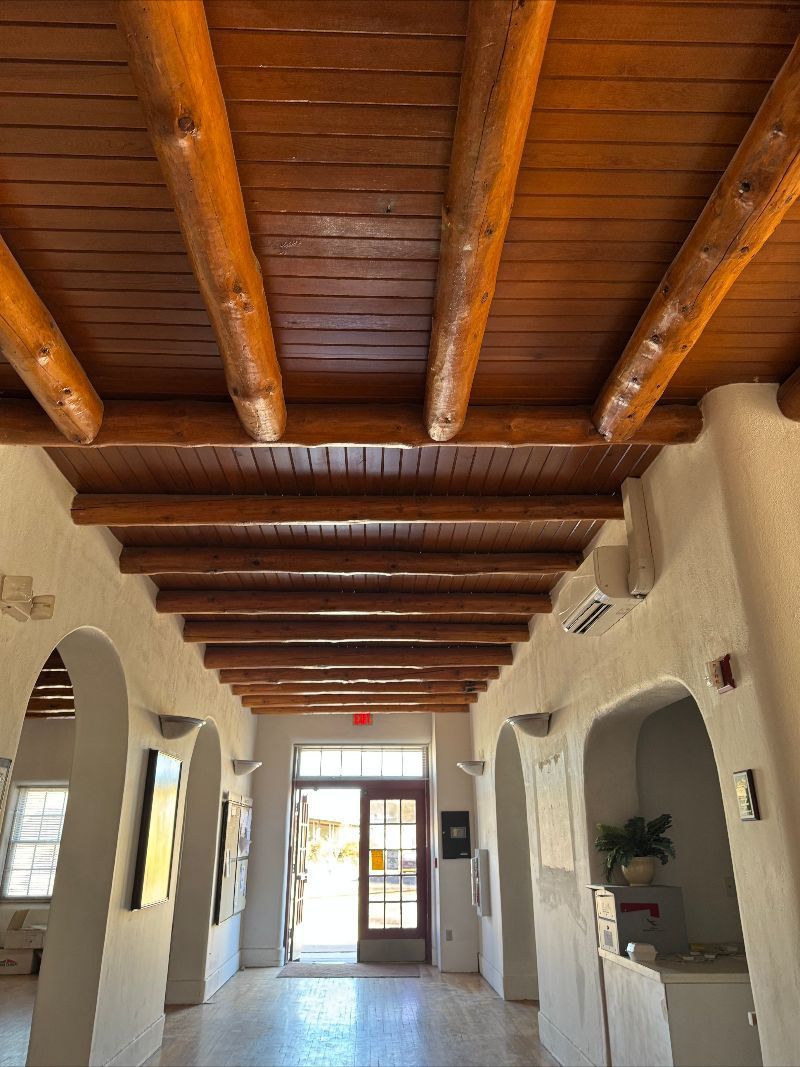
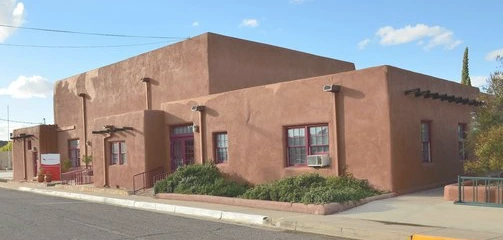
What a wonderful state we live in. January’s TEG Tour took us to Truth or Consequences, New Mexico—formerly known as Hot Springs prior to 1950. It’s a place rich with history and character: echoes of Geronimo, a thriving artist community, healing hot springs, the wide-open southern New Mexico countryside, Elephant Butte Lake, and deep family ties. As someone who grew up in T or C, I find that I appreciate it more deeply as the years go by, seeing it now through a different lens.Our visit centered on the Lee Belle Johnson Building, located in the heart of town. This large adobe structure was built in the 1930s as part of the Works Progress Administration (WPA). Over the decades, it has served many purposes—among them a dance hall, town hall, library, senior center, and even a visitor center for Spaceport America. Today, the building sits idle, awaiting its next chapter.Given its age, the building remains in relatively good condition. However, concerns have been raised about water accumulation in the crawlspace, and there are visible signs that the roof will require attention in the near future.On a personal note, this building holds many memories for me. I participated in a Chubby Checker twisting contest there as a 9- or 10-year-old in the early 1960s, and nearly 50 years later, we celebrated my late mother’s 80th birthday in the same space. One cherished photograph shows my father—who was serving as County Clerk at the time—handing a couple their marriage license outside the building. Circa April 4, 1954 when it was the Community Hall.The Lee Belle Johnson Building clearly has many more years of community use ahead of it. It is easy to support the community’s efforts to do what is needed to preserve and “save” this historic structure. Our host, City Manager Gary Whitehead, appears committed to that goal. With continued encouragement—and perhaps a bit of thoughtful guidance—we are hopeful that this important landmark will once again serve the people of Truth or Consequences.Pat Martinez Rutherford - TEG Board Member TEG Tour – March 14, 2026 – Santa Fe, NMOur next TEG Tour takes us to Santa Fe on Saturday, March 14, 2026! We will be visiting a straw bale constructed home with interior and exterior earthen construction plaster. The interior walls are finished using American Clay’s Merittimo plaster. The bedroom is finished with a reddish earthen plaster. The fireplace and half wall is constructed using adobes. The Tour will be limited to 20 participants. If you want to attend, please RSVP to theearthbuildersguild@gmail.com. Members are free. Non-members are $10. Directions will be provided once you have RSVP’d.We will be holding our TEG Board Meeting at 9:00 that morning and gathering for a no-host lunch at a local eatery. Let us know if you would like to attend either or both.Pat Martinez Rutherford - TEG Board Member Salvaged Clay ChallengeFor several years now I have been working to coordinate the retrieval and saving of clay material that is being deposited in large quantities by the Albuquerque-Bernalillo County Water Utility Authority (WU for short) as part of their water usage of the Rio Grande River. If you would like to know more about this project, please look back at the October 2023 TEG Newsletter article that I wrote laying out the details of what this project is about. I would like to describe the current situation and ask for thoughts and ideas from you, our esteemed readers. |

This is a picture of the settled clay material at the WU. The depth of this material is around 8ft. over the majority of the basin. There are two basins of approximately the same size. This is what was removed, with almost all of it being mixed with a binder that renders it unusable as normal clay as we know it.
The clay retrieved for us by the WU folks from the project focused on cleaning out their water settling basins has been set aside for our potential uses. There is approximately 2,800 yards of this material, and it will be protected in place at the WU property adjacent to the water basins. The WU folks have agreed to leave this material in place with the caveat that it needs to be removed within 4 to 5 years so that the next cleaning effort has a place to deposit the material coming out then. This is the good news. |
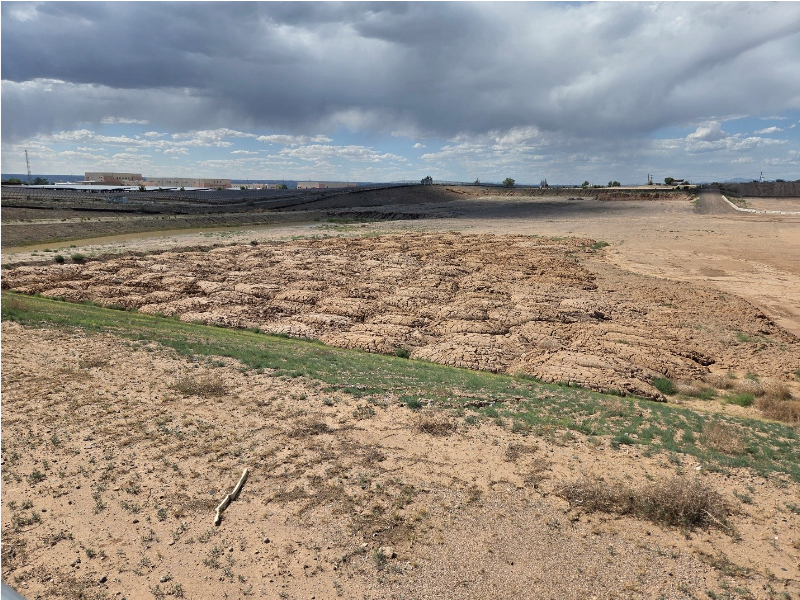
This is a picture of the clay material that the WU has set aside for us. There are about 2,800 yards of clay in this picture, it being the pile of mounds you see in the middle of the frame. Each of the mounds was dumped by a full sized (~ 20 yard) end-dump truck.
The rest of the story has some potential problems. First, the material must be retrieved from the WU storage location by large trucks, either a tandem dump truck or an end-dump truck. The loaders that the WU used to move our material, along with the other ~160,000 yards of unusable material, are quite large so they can’t really load anything smaller than these larger trucks. Additionally, these WU loaders are fully used during the operational part of the year for the WU ongoing operations, so there is only a short 2-3 month window during each of the next 4 years that we can retrieve this material. Generally, this will be mid-June through mid-September. |

This picture shows one of the WU loaders putting the first load of good clay into an end-dump truck. It took only a matter of minutes for this loading to finish.
I had to arrange the hauling with a local trucking company that has the right sized truck to take this size of load, and, while not overly expensive, it was necessary to coordinate the access to the storage site with the WU along with the need to have two trips to get just about 40 yards of the clay down to my business location. It made for a long day driving back and forth through Albuquerque’s roads, including navigating major road work on the connecting I-25 interstate highway. |

This picture shows the end-dump dropping its load of clay at our production site.

This picture shows approximately 40 yards of clay at our production site. As you can see, the material is not some fine powdery stuff but instead is quite lumpy. The lumps are not very hard since the clay is not geologically hardened, but it still presents a hurdle in terms of its usage.
This is where the request for possible input comes in. For most users of material like this, it is important to reduce the lumps down to the necessary size to suit their particular operations. For my business of stabilized CEB production, having lumps of clay in our raw material matrix presents fairly serious problems. The ideal is to have powdered clay that can be mixed in the right proportions with the non-clay minerals. Lumps of clay greater than around a BB (4-5mm diameter) present a problem in that they cannot be stabilized. If these lumps are on the surface of a block, they will quickly take up moisture and eventually (and pretty quickly) wash out and leave pock marks. While not terribly destructive, this makes the blocks suspect in terms of durability not to mention appearance.I would like to ask anyone who has an idea for how to use this material on a larger scale to please contact me. The companies that are part of the original request to the WU to set this material aside are still working to determine whether they can utilize this material given the state that it is in. While a few small projects might be possible, this clay is primarily to be used to figure out if, in the future, the majority of the next WU basin-cleaning project material can be used economically and beneficially without destroying its clay nature.I am more than happy to share amounts of these 40 yards of clay if you have an idea that you want to explore, but you will need to have a means of transportation along with a pretty clear explanation of what you believe it could be used for. I will need to pass along your idea to the WU folks that are championing this effort since they have the responsibility of managing and justifying the costs to set this material aside for our use.Please feel free to contact me directly with any questions or to get more information.John Jordan - TEG Chair, President of Paverde LLC (john.jordan@paverde.com) |
TEG Community Outreach Feedback SurveyThe TEG Board would appreciate your feedback on how we outreach to the community. The survey will only take 2-minutes to complete. Click the appropriate link below that corresponds to your affiliation with TEG,If you are a current member of TEG, please utilize this link:https://www.wixforms.com/f/7369885243332887581If you are a former member of TEG and/or a newsletter subscriber, please utilize this link:https://www.wixforms.com/f/7369860628741096602Louis Edwards - TEG Board Member |
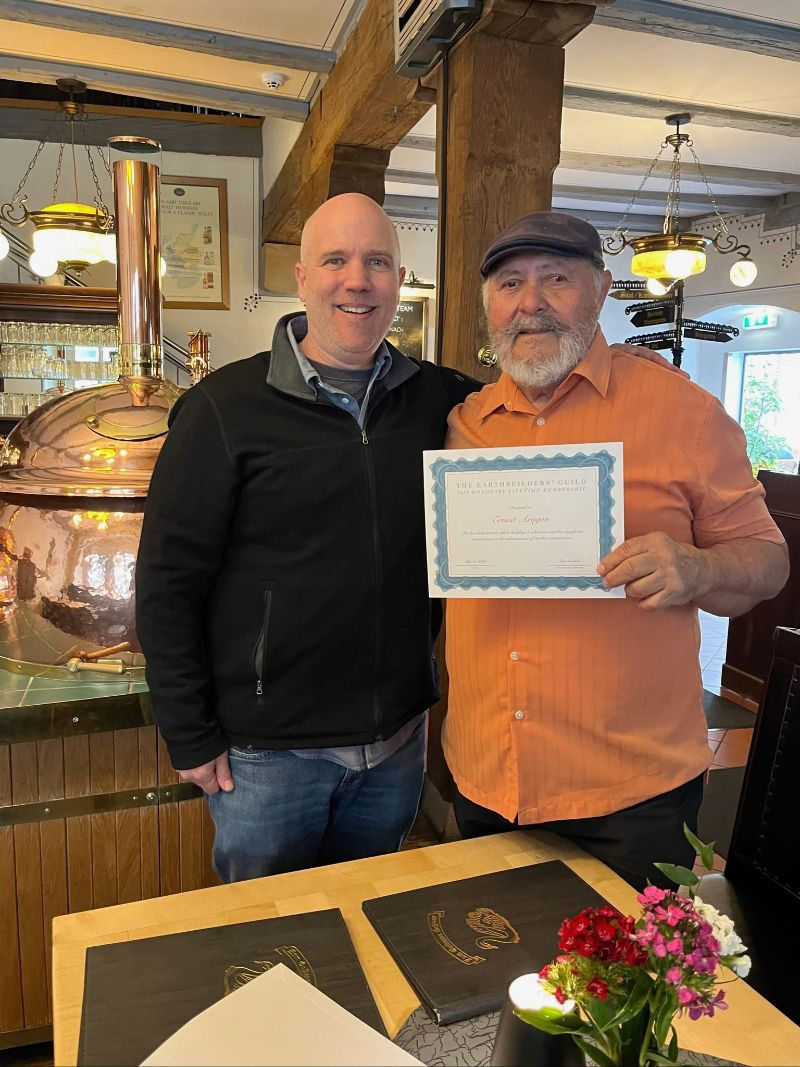
TEG Honorary Membership NominationsThe Board of Directors is accepting nominations for Honorary Lifetime Membership in TEG for 2026.Find the criteria below. Deadline for nominations is March 1, 2026.Please email your nomination to theearthbuildersguild@gmail.comHonorary Lifetime Membership CriteriaOne Honorary Lifetime Membership may be awarded to a member of the earthbuilding industry annually, with a two-thirds majority approval of the Board of Directors. Nominees should be submitted in writing to the Board by any member(s) in good standing, with a description as to why the nominee should receive this recognition, along with the material to substantiate the reasoning. The nominee should be of good character, meet TEG’s ethical standards and must meet at least two of the three criteria listed below for consideration. Submissions must be received by March 1st of 2026; the Board will announce its decision by the end March. It is the discretion of the Board to award the honor every year.Advancement of Earthen Construction
Service to the Community
Service to the Trade and Organization
Our Honorary Lifetime Members
Pat Martinez Rutherford - TEG Board Member |
Newsletter Invite for ContributionsWe want to hear your story!Do you have an earthbuilding story to share? Consider contributing to our quarterly newsletter. TEG welcomes any earthen news, achievement, anecdote, reflection, or personal story related to the fields of adobe, compressed earth block, rammed earth, or cob. Be sure to share your photos, as well! Email us for more info: theearthbuildersguild@gmail.comPat Martinez Rutherford - TEG Board Member |
Adobe in Action - Latest News

Mud Talks #37 with Lea Marta Andersson - Earthen Plaster Project
Twenty students are currently working their way through Adobe in Action's first online class of 2026 - Passive Solar Adobe Design. After coming up with their own floor plans in the early modules of the course, students are now running heat gain / heat loss calculations and making tweaks to their designs to balance their homes.Adobe in Action is celebrating its 15th year of offering online classes in 2026. Our next online class - NM Adobe Building Permit Process - begins on Monday, February 16th. More info about that class can be found here. See our full winter/spring 2026 online schedule here. Join us for a class to celebrate our 15th year of adobe education for owner builders! 2026 field workshops will be announced soon.Finally, you can listen to the latest episode of our Mud Talks Podcast - Mud Talks 37: Integrating Earth into Art and Conservation Practice with Lea Marta Andersson here.Kurt Gardella - TEG Board Member, Adobe in Action Executive Director and Instructor |
SFCC Adobe Program - Latest News

Co-lead faculty / field instructor Issac Logsdon will be focusing on adobe plaster and preservation topics as part of the field workshops this spring at SFCC.
The Santa Fe Community College Spring 2026 Adobe Construction semester is up and running. There are still a couple of open spots in the two courses that begin on March 16th. These courses use a blended learning format (50% online + 50% field work) and are great for students who don't time to attend during the workdayADOB 1115 - Finish PracticesDates: 03/16 to 05/16/2026 (class meets in person on or off campus March 28, March 29, April 11 and April 12)Format: Blended (50% online + 50% field work)Instructors: Kurt Gardella and Issac LogsdonADOB 1118 - Preservation PracticesDates: 03/16 to 05/16/2026 (class meets in person on or off campus April 25, April 26, May 9 and May 10)Format: Blended (50% online + 50% field work)Instructors: Kurt Gardella and Issac LogsdonView the full Fall 2026 online schedule here: https://sfccssb.sfcc.edu/PROD/pw_pub_sched.p_listthislist?term_in=202530&subj_in=ADOBFull details the Adobe Construction Program at SFCC can be found at: https://www.sfcc.edu/programs/adobe-construction/Kurt Gardella - TEG Board Member, SFCC Adobe Program Co-Lead Adjunct Faculty |
Earthen LegendsTEG has begun a project of compiling bios/stories of those people who have passed away who contributed to our industry over the years. We are interested in receiving bios from anyone who can add to our library of knowledge in a salute to those who make up the history of earthen construction. Send your submissions to theearthbuildersguild@gmail.com.Criteria for submissions to Earthen Legends:
|
View from the ChairFebruary 10, 2026Greetings, Fellow TEG members and Earthen Aficionados,It has been an overly warm winter here in the desert Southwest. The hottest December and fifth hottest January on record if I am not mistaken. This is not some passing situation that will right itself, at least not without our participation. I have heard some people argue that it is too late, that the dramatic changes to Earth’s environment are so deeply set that we simply have to accept the inevitable outcome. I went through this mindset back in the mid-1990’s, when, as I was pursuing my BS in Biology, a visiting professor spelled out the already discernable dramatic shifts in the CO2 levels in our atmosphere. I got it, and it caused me about 5 years of what my wife called my “doom and gloom” years. Fast forward to now, and I have a mixed set of feelings about our future environment. What is apparent is that there is much to be learned about the numerous and widely varied efforts that so many people are engaged in to try to avert climate catastrophe. They must believe that their efforts, no matter how small or how often they do them, can help this cause. That is what motivates me now, and it is a welcome change from the grimly dark future that I once thought was a foregone conclusion. It is also what makes me think about the role that we, as earthen-focused folk, can and do play in this cause.There are a number of undebatable, and very definable characteristics of earthen construction. While most of these are based on the physics of mass and also on geochemical interactions between the constituents of these materials, there is also the possibility that these materials provide a pathway towards changing the equation of carbon loading in our atmosphere. The very nature of the thermal mass aspect is that less energy is needed to provide a comfortable space within the home. This is beyond doubt, and I do think that this is, arguably, the most beneficial aspect of earthen on an individual basis, but it is also not the only argument for our chosen material. Other aspects that are inarguable include the sustainable nature of our materials. While it is not 100% carbon free mainly because of the current equipment needed to harvest and transport the raw materials and finished products, the fact that generally these materials need to be locally sourced means that much of the fuel usage can be minimized. Additionally, in many cases the raw materials can be found as part of other on-going operations such as gravel producers, so it is already being “subsidized” by the harvesting of other related mineral products. The fact is that earthen materials can in nearly every way be dramatically less energy consumptive than other construction materials. This, along with the sustainability factor, makes for a compelling argument that earthen can and should be put forward as one of the highly effective means to combat climate change.One of the questions I have asked myself and others, albeit somewhat in terms of a marketing approach, is “what kind of home would you want to be living in if there were to be a grid shutdown, both gas and electric?” Of course, we know that frame type super-sealed “green” homes provide copious amounts of insulation. What is not mentioned very often is that once the internal heat energy (or cooling) has escaped by opening the doors, then nothing further can be done to alter nature’s directives of energy movement until some source of energy is restored. Earthen structures, on the other hand, will continue to provide a mitigating effect for many days, usually enough to get through whatever situation might be happening. Additionally, if needed, lesser amounts of energy, say from an emergency generator, can be used within the structure to put the latent energy back into the walls, keeping the emergency energy usage much lower than needed for a frame/insulation home. At least this is what I have come to understand about how our material behaves. There is much real-world evidence to back this up, but how to tout this benefit in a time where we have come to rely on and expect that the grid utilities will always be there as our primary suppliers. This will probably remain true throughout most of our lives, but in the not-too-distant future I do believe that there will be enough challenges in our world and this may not be the case. I again ask, with a slightly different emphasis, then what kind of home would you prefer for your children and their children?I do believe that our answer of living in earthen constructed homes addresses at least some number of the environmental issues we are facing. How we move forward with this answer is what we wrestle with constantly. Having faith that this is a worthy cause is tangibly evidenced by the earthen materials that we produce and use, the indisputable proof being the dwellings that have, do, and will exist as long as we persevere.With hope and warm wishes,John Jordan - TEG Board Chair (chair@theearthbuildersguild.com)P.S. I received a very thoughtful response to my article in the last (Nov. ’25) TEG newsletter. It was from Susan Clellen, and as promised some time ago for any responses that I receive, I will share her message.Your essay in the EBG was interesting. I wonder who your intended reader might be? As an adobe builder, gardener and former potter/ ceramic artist, I never ... ever ...viewed clay or earth as anything other than a "miraculous" medium. It has chemical and mineral characteristics all too often ignored or disregarded. We should elevate clay and earth to its rightful status and discribe it as such. We will only then be able to move forward with the general perceptions ... mud is not mud. Adobe has properties BECAUSE it is alumina, silica, water....etc.There is a culture in pottery centered around clay and hands that speaks to the magical connections. We should approach adobes with such...respect. Elevate us from "dirt".. please.Peace.S.I deeply respect your opinion and your high regard for our irreplaceable ingredient, clay. Without it, there are no adobes, no CEBs, no fired clay bricks, no mud plaster, no rammed earth, no cob, or even wattle and daub. We would have, essentially, no durable natural construction materials other than hewn stone and cement-based materials would be the only binder you could use on sand and aggregate, at least on a commercial scale. I did not intend to denigrate our wonderfully useful materials, but in truth, most of what we use for our earthen construction products is an amalgam of clay, silt, sand, and aggregate, with the ratios and additives (fiber, stabilizers, etc.) being optimized for the particular application(s). What is necessary for earthen products that are not fired or overly stabilized is this blend of materials that most would refer to as “dirt”. What I would hope is that by us earthen practitioners elevating the term “dirt”, that we then make the buying public more comfortable with the whole concept of earthen dwellings.Susan, thank you for your thoughtful response. I know that this discussion will probably continue into the foreseeable future, with passion and patience!John Jordan - TEG Board Chair (chair@theearthbuildersguild.com) |


Comments